


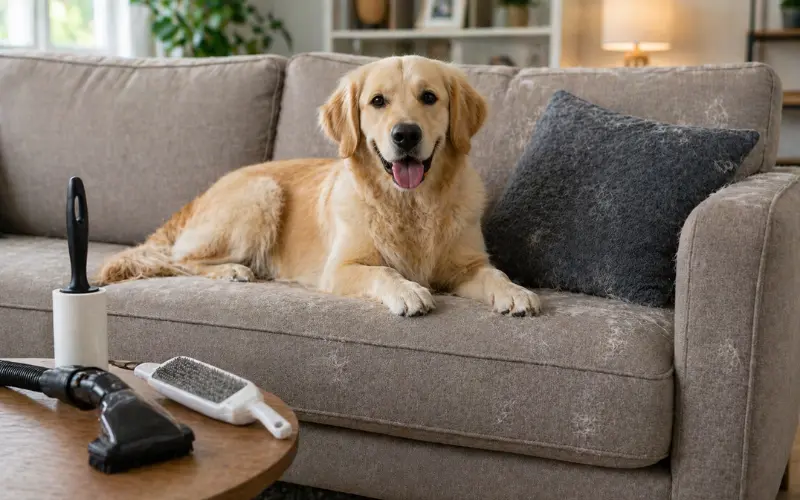

The struggle to remove pet hair and odors from upholstery is real. Most homeowners find that, despite regular vacuuming and brushing, hair embeds deep into fibers, clings stubbornly to sofas and chairs, and odors seep into cushions, leaving rooms less fresh.
Being in the upholstery cleaning business for years, we’ve seen how hair returns within days, odors multiply, and it becomes exhausting and discouraging for pet owners to consider cleaning again.
Our cleaning team notes that the issue isn’t a lack of effort; it’s the random execution without a proper plan. Homeowners try different methods week to week, but with no structured approach, results fade quickly. That’s why our experts decided to share their strategic inputs so pet owners can get better results.
Why Removing Pet Hair and Odors from Upholstery Matters?
Pet hair and odors, when stuck to the upholstery, ruin its appearance, damage the fabric, and allow microorganisms to thrive, forming an unhygienic environment. Dust, dander, and allergens trapped in upholstery fabric worsen indoor air quality, while odors multiply and linger around.
The U.S. Environmental Protection Agency warns that pet dander (dead skin cells and fur shed by pets) compromises IAQ and triggers respiratory issues such as asthma. Likewise, the American Lung Association suggests that pet dander in soft furnishings is often responsible for hay fever and respiratory issues, a finding our cleaning crew regularly observes in client homes.
Many of our clients shared instances, highlighting how dirty upholstery caused massive health issues. Thus, we always stress strategic pet hair and odor removal to protect furniture integrity while securing household health.
Expert-Backed Options to Remove Pet Hair and Odors from Upholstery
Many homeowners fail to remove pet hair and odors from upholstery because they don’t follow the right order — they try to clean odors before removing the hair first. Yes, it’s recommended to address fresh urine accidents to prevent fabric damage and maintain hygiene; Still, random scrubbing or vacuuming can push dander deeper, reduce vacuum efficiency, and still leave odors behind.
Our upholstery cleaning specialists suggest a simple sequential approach:
“First, remove pet hair, then proceed with pet odor removal on upholstery”
This sequence works because removing hair first clears the surface, and odor removal solutions can penetrate upholstery fabric easily without hairy interference. Now, you are probably wondering what your options are for effective pet hair and odor removal.
Here’s what our experts recommend for removing pet hair on upholstery:
Option #1: Lint Rollers and Tape
Easily available, these small sticky tools are ideal for light to moderate pet hair accumulation. The hair sticks to its surface instantly, clearing upholstery fabric.
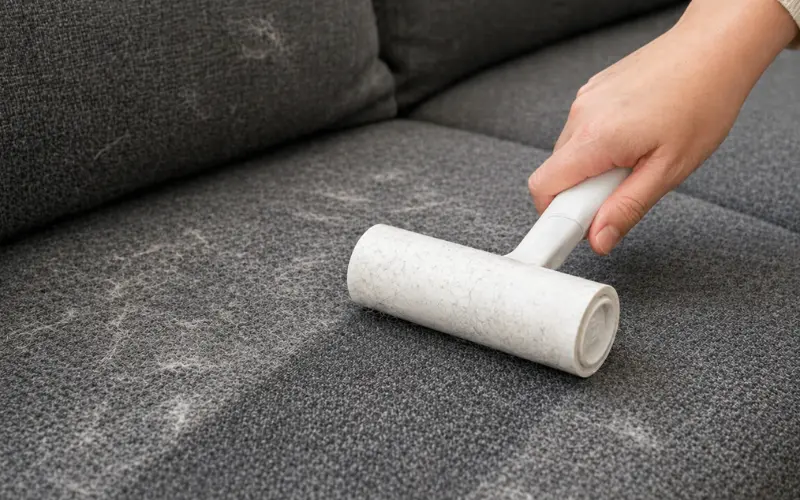
Here’s how you use lint rollers and tape:
- Glide a lint roller across the upholstery fiber to capture loose hair strands.
- For heavy shedding, wrap packing tape around your hand (sticky side outwards) and press gently to lift fur from dense areas. You can also do this after using lint rollers to remove tiny hair remains.
Pro tip: Avoid pressing too hard or rolling continuously in the same area since it can weaken your upholstery fabric and leave excessive sticky residue.
Option #2. Rubber Gloves and Squeegees
Hair embedded in cushion seams and broad fabric areas, such as sofas, can be removed with rubber gloves and squeegees.
Here’s how you use rubber gloves and squeegees:
- Use damp rubber gloves to sweep across the fabric. The free movement of your hands gives you precise control in tight or curved areas, while static friction gathers hair into clumps for easy disposal.
- After swiping hair with gloves, use a rubber squeegee on wide, flat sections to drag remaining strands into neat piles, which can easily be removed with a vacuum.
Pro Tip: Use only mildly damp gloves. Upholstery cleaning professionals caution against over‑wetting, as excessive water can spread and weaken upholstery fibers.
Option #3. Electrostatic brushes or rollers
These tools generate static charge, pulling embedded strands into a chamber that’s easy to empty. They are perfect for moderate to heavy hair build-up on fabric surfaces, and the refill-free, eco-friendly design makes it a feasible option.
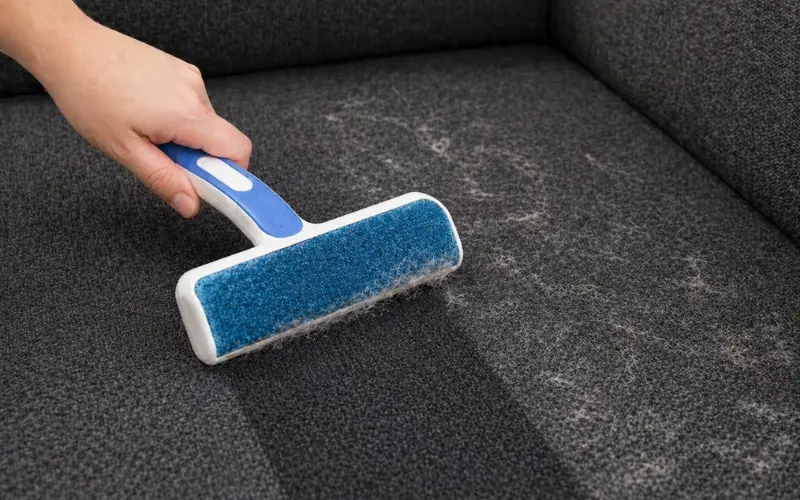
Here’s how you use brushes or rollers:
- Slide the roller or brush across the fabric to lift and collect pet hair efficiently.
- Once the chamber is full, empty it outdoors and continue until the surfaces appear clear.
Pro Tip: Avoid rapid back‑and‑forth strokes to avoid scattering of hair. Also, doing so reduces static effectiveness. Technicians will always recommend slow, consistent passes to maximize lift and keep removal controlled.
Option #4. Mitts or Cloths
Experts suggest using mitts or cloths for delicate fabrics and tight creases such as cushion seams, sofa corners, or chair backs, where harsher tools might snag or weaken fibers. Microfiber mitts give you gentle control when you need to remove pet hair and odors from upholstery on delicate fabric areas.
Here’s how you use cloths or mitts:
- Wipe in one direction across the furniture fabric using a microfiber mitt or cloth to lift hair strands, then shake or rinse the mitt outdoors to clear.
- For stubborn pet hair strands, use a clean spray bottle of water before wiping, as moisture improves fiber grip while loosening hair and easily clings to the fiber cloth used for removal.
Pro Tip: Don’t scrub back and forth; otherwise, pet hair pushes deeper into the fibers. We recommend that you execute single controlled passes to maximize lift while protecting upholstery texture.
Option #5. Vacuuming
Always finish hair removal with vacuuming, as even after using gloves, cloth, or brushes, small traces of pet hair remain. A final sweep ensures there’s no strand left.
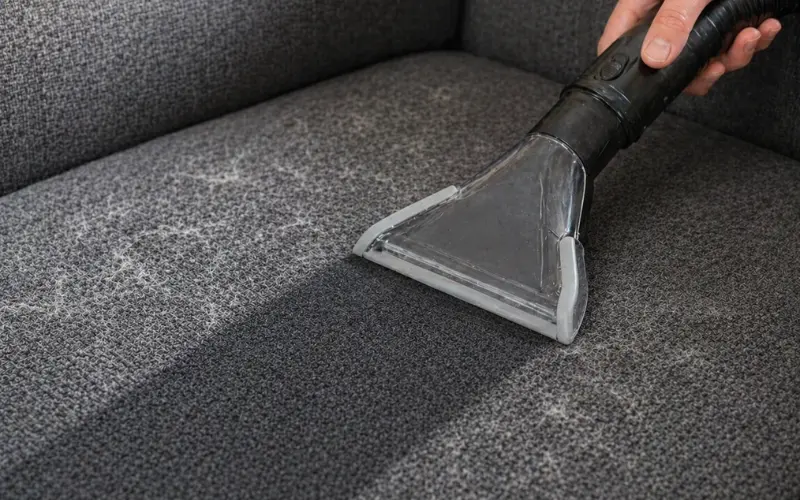
Here’s how you use a vacuum:
- Use an upholstery nozzle with rubber or silicone edges on your vacuum, then slowly move it across the fabric to grip and loosen hairs before suction removes.
- Target seams, piping, and corner areas to eliminate hidden hair.
Pro Tip: Don’t rush passes or use high-power suction on delicate upholstery, as this can stress fibers. Keep steady, moderate suction with specialized nozzles for a thorough and safe finish.
Best Options to Remove Odor From Pet Urine on Upholstery
Once you are done removing pet hair from your upholstery, it becomes easy to eliminate odor, especially if you have experience removing pet odor from carpet. Below are some home remedies suggested by us that can help you:
Option #1. Baking Soda
One of the simplest yet best household remedies for neutralizing pet odors trapped deep in upholstery fibers. Technicians have often observed that its natural alkalinity breaks down acidic odor compounds, making it very effective for pet urine and lingering smells.
- Sprinkle baking soda over the affected areas.
- Brush it gently into the fabric using a soft brush to ensure penetration, then leave it for several hours or overnight.
- Vacuum thoroughly with an upholstery nozzle to remove the spread powder that has absorbed odor overnight.
Pro Tip: Don’t rush the dwell time; removing baking soda too soon limits its deodorizing effect. We recommend giving it ample time to absorb before vacuuming for lasting odor control.
Option #2. Water Vinegar Mix
For tough urine spots releasing bad odors, vinegar can be a useful remedy. Its natural acidity breaks down odor-emitting compounds at the source instead of just masking the odor.
- Mix white vinegar and water in equal proportions in a clean spray bottle.
- Spray lightly across upholstery until damp but not soaked, then blot with a clean cloth to lift residues and odor particles.
- Allow the fabric to dry as the vinegar scent fades; it removes the pet odor with it.
Pro Tip: Avoid oversaturating fabric. Excess liquid can seep into the padding and extend drying time. Our team recommends light, even sprays for effective pet odor removal without inflicting damage on upholstery.
Apart from baking soda and vinegar, you can also try combinations like salt + baking soda, cornstarch + baking soda, and vinegar + salt solution. These natural remedies provide safe, fabric‑friendly ways to neutralize odors. If the odor is still persistent, it’s a clear sign you need help from professionals like us.
How Professional Upholstery Cleaning Can Help Remove Pet Hair and Odor
We firmly believe professional care should be recommended only when it’s truly needed. That’s why whenever our clients reach out to us, we firstly encourage them to start with simple DIY methods and observe the results. If odors persist or high‑activity areas aren’t cleaned due to heavy pet hair buildup, we suggest scheduling our upholstery steam cleaning services. When DIY methods aren’t enough to fully remove pet hair and odors from upholstery, professional steam cleaning fills the gap with deeper extraction.
Whether it’s everyday seating or specialty pieces, here’s what you can expect from our professional team, which specializes in upholstery steam cleaning:
1. Pre‑Inspection
We begin with a careful evaluation of upholstery fabric and the extent of pet hair and odor. This helps us determine the safest cleaning approach.
2. Pre‑Treatment
Fabric‑safe solutions are used by our cleaning crew to loosen deeply embedded pet hair, oils, and odor residues without damaging fibers.
3. Deep Steam Cleaning
After inspection and pre-treatment, our team proceeds with an advanced steam cleaning method that penetrates deep into upholstery, extracting pet hair, dander, allergens, and odor‑causing bacteria. It’s the core of our process, and helps restore freshness while ensuring fabric integrity. This is the most powerful step to remove pet hair and odors from upholstery at a level no household tool can replicate.
4. Spot Treatment
Persistent urine spots or heavily soiled areas get targeted treatment, so maximum odor removal and thorough cleaning are possible without damaging the fabric.
5. Deodorizing
Using standard eco-friendly deodorizing agents, the group of technicians neutralizes pet odors at the source, refreshing the entire upholstery.
Our team continues cleaning until they feel the pet hair and odor are effectively removed and wraps up the process with a final inspection.
Get Rid of Pet Hair and Odors from Your Upholstery With Steam Cleaning Experts
To remove pet hair and odors from upholstery is tricky. DIY options can only work if you are precise with the approach and execute the steps well. The results last longer when you use them smartly. Our experts believe that if DIY techniques are used as a maintenance strategy to amplify the results of professional upholstery cleaning, the results can be significantly more effective and longer-lasting.
California Steam Team has 25+ years of experience in upholstery cleaning. With a proven upholstery steam cleaning process, our specialists provide deep dirt removal, fabric protection, and a refreshed look while extending the life of your furnishings. Using gentle yet powerful steam cleaning technology and eco-friendly solutions, we revive your furniture’s look and free it from pet hair and odor, making it clean again.
Book your upholstery cleaning session with the top experts in town!
FAQs
Q. How often to professionally clean upholstery with high pet activity?
Most couches and chairs benefit from cleaning every 18 to 24 months. If pets spend daily time on upholstery, yearly cleaning helps. However, for extremely aggressive pet households, bi‑annual cleaning is often recommended by us to keep upholstery fresh, hygienic, and long‑lasting.
Q. How do I protect my upholstery?
Our in-house experts stress using disposable sheets, washable fabric covers, and regular pet grooming as precautionary measures to keep upholstery safe and reduce hair and odor buildup.
Q. How toxic is dog urine in a house?
Dog urine in a house isn’t toxic, but ammonia fumes, bacteria, and uric acid can compromise your health. A quick cleanup, especially from upholstery, is crucial to prevent odors, which may trigger respiratory issues.
Q. What is the best way to remove pet hair from couches?
The best method depends on how often your dog sheds and how much hair accumulates. For instance, light, occasional shedding, lint rollers, or microfiber cloths work well. For heavy or frequent shedding, we recommend upholstery‑specific vacuum attachments for deep removal.